The R307 is a standalone optical fingerprint sensor module that captures, processes, stores, and matches fingerprints entirely onboard without requiring any external processing.
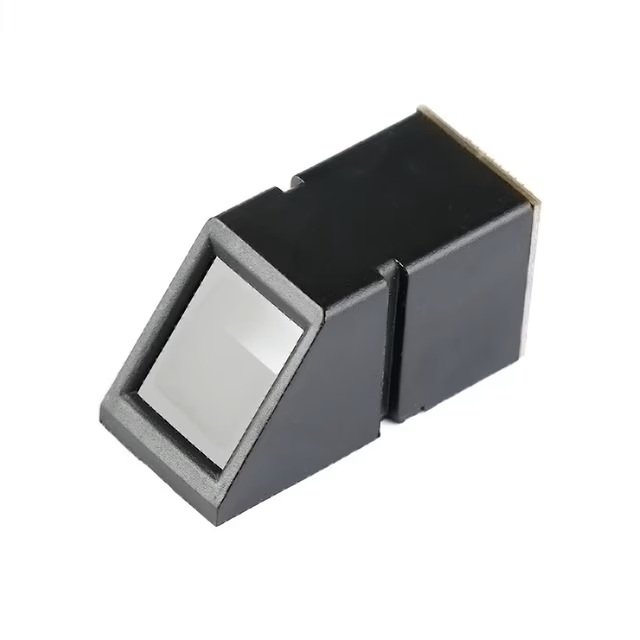
By combining an optical imaging sensor, a high-speed DSP processor, a fingerprint alignment algorithm, and high-capacity Flash memory in a single compact module, it handles all biometric operations independently and communicates results to the host over a simple TTL UART or USB interface.
Pinout
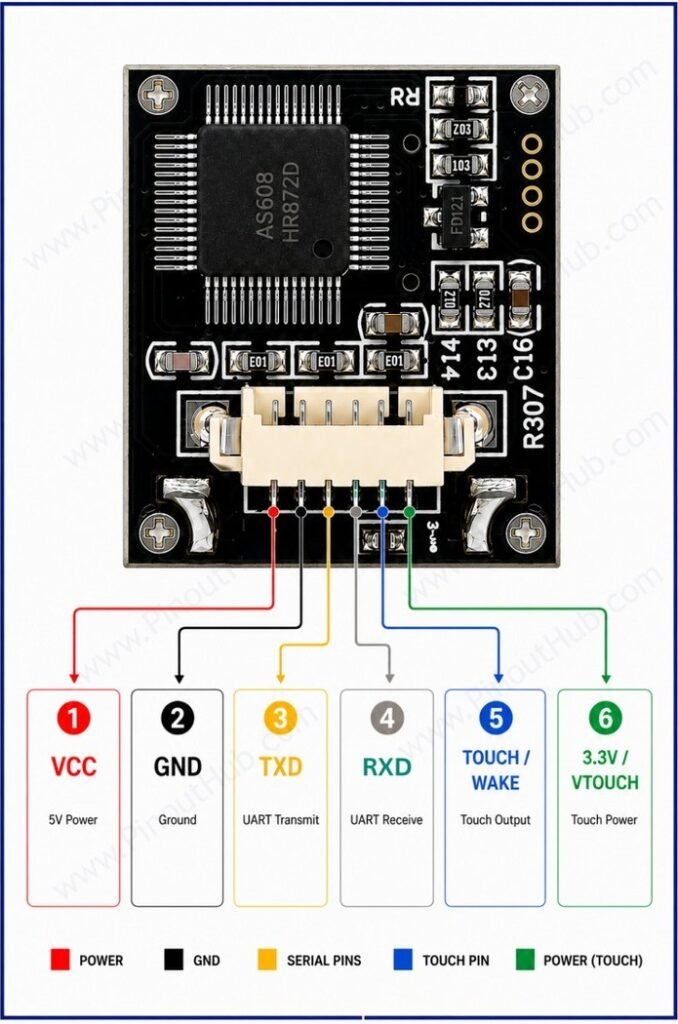
6-wire cable pinout (common maker variant)
| Pin No. | Pin Name | Type | Description |
|---|---|---|---|
| 1 | 5V (VCC) | Power Input | Connect to 5V DC |
| 2 | GND | Ground | Ground connection |
| 3 | TXD | Output | UART Transmit → Connect to MCU RX |
| 4 | RXD | Input | UART Receive → Connect to MCU TX |
| 5 | TOUCH | Output | Finger detection signal (goes HIGH/LOW depending on module configuration) |
| 6 | 3.3V | Power Input | 3.3V supply for the touch detection circuit or 3.3V operation (module-dependent) |
Module Construction
Optical Image Sensor An area-array optical sensor positioned beneath the glass scanning window. Captures a 256 × 288 pixel grayscale image of the fingerprint placed on the window surface. No lens is present between the sensor and the glass — the sensor captures a direct contact image of the fingerprint ridges.
Blue Backlight LED Assembly A set of blue LEDs inside the module housing that illuminate the finger from below through the glass window during scanning. The backlight does not remain on continuously — it is activated only when a scan command is issued over UART. The blue light enhances contrast between fingerprint ridges and valleys on the optical sensor.
AS606 DSP Processor The main processing IC, containing multiple RISC processor cores and integrated DSP capability. Handles all image processing, feature extraction, template generation, template storage management, and fingerprint matching entirely onboard. The host microcontroller never receives raw fingerprint image data during normal operation — only command responses and match results.
Onboard Flash Memory High-capacity Flash storage holding up to 1000 fingerprint templates of 512 bytes each, plus the characteristic files and system parameters. Templates are non-volatile and persist through power cycles.
Onboard Voltage Regulator Steps down the 4.2–6V supply to the internal operating voltage required by the sensor and processor. A solder jumper on the PCB bypasses this regulator when 3.3V direct supply is used.
Touch Sense Circuit A dedicated circuit connected to the TOUCH VCC and TOUCH OUT pins that detects the capacitive or conductive presence of a finger on the scanning window surface. Outputs a HIGH signal on TOUCH OUT when a finger is detected.
USB Interface A USB connector on the module body that implements USB 2.0 / USB 1.1 and creates a virtual COM port when connected to a PC. Useful for development, enrollment, and testing without a microcontroller.
Specifications
| Parameter | Value |
|---|---|
| Supply | |
| Supply Voltage | 4.2V – 6.0V DC (3.3V via jumper) |
| Working Current | 50mA typical |
| Peak Current | 80mA |
| Imaging | |
| Sensor Type | Optical |
| Resolution | 500 DPI |
| Image Buffer | 256 × 288 pixels |
| Scanning Window Area | 14 × 18mm |
| Backlight | Blue LED |
| Image Entry Time | < 0.3 seconds |
| Fingerprint Processing | |
| Characteristic File | 256 bytes |
| Template File | 512 bytes |
| Storage Capacity | 1000 templates |
| Matching Modes | 1:1 / 1:N |
| Security Levels | 5 (adjustable) |
| FAR | < 0.001% |
| FRR | < 1.0% |
| Search Time | < 1.0 second (1:1000) |
| Verification Speed | 0.2 seconds |
| Interface | |
| Communication | TTL UART / USB 2.0 |
| Default Baud Rate | 57600bps |
| Baud Rate Range | 9600 – 115200bps |
| General | |
| Sensor Life | 100 million touches |
| Anti-Static Rating | 15kV |
| Operating Temperature | −20°C to +40°C |
| Storage Temperature | −40°C to +85°C |
| Operating Humidity | 40% – 85% RH (non-condensing) |
Helpful Resources
- Download the datasheet: here
- R307 with Arduino
- R307 with ESP32
- R307 with Raspberry Pi