Unlike previous ESP32 variants, the ESP32-C6 introduces Wi-Fi 6, Bluetooth LE 5, and IEEE 802.15.4 (Zigbee/Thread) support, making it ideal for modern IoT ecosystems.
It is powered by a RISC-V based processor, marking a shift from the traditional Xtensa cores used in earlier ESP32 boards. This change improves efficiency and aligns with newer open architectures.
This guide provides a detailed look at the ESP32-C6 DevKitC-1 pinout.
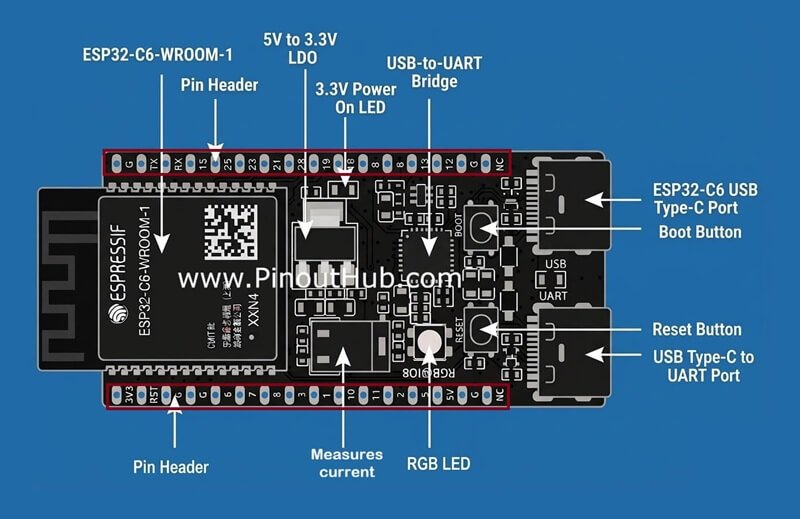
ESP32-C6 DevKitC-1 Pinout
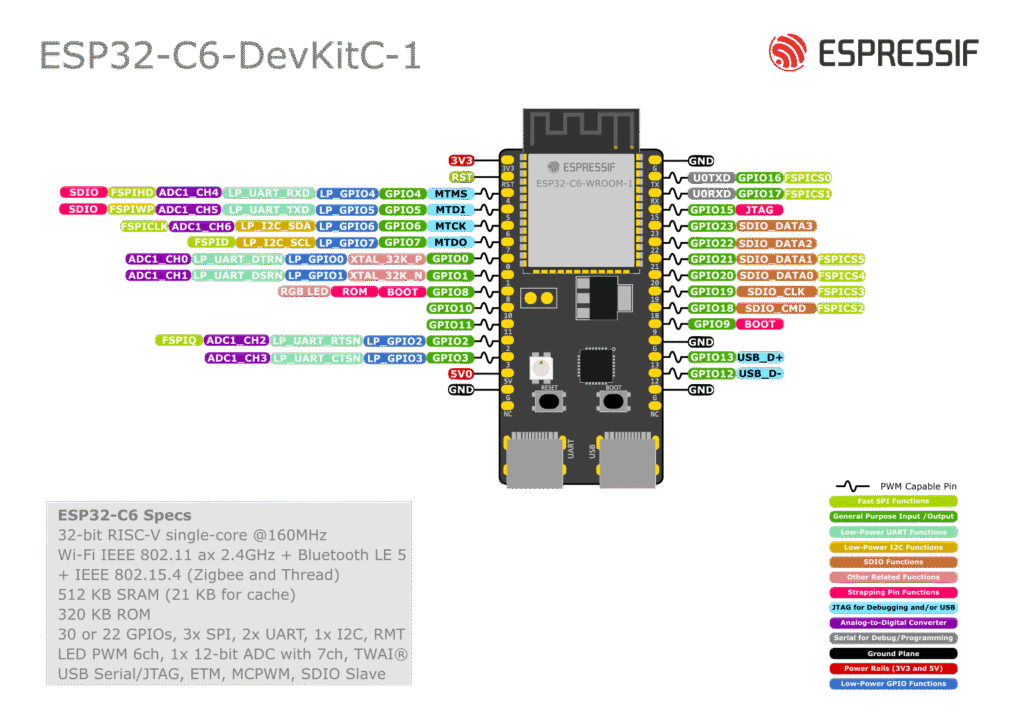
Power pins
- 3V3: 1 pin
- 5V: USB input / VIN – 1 pin
- GND: 4 Pins
ADC Pins
ADC supported on:
- GPIO0 – GPIO6
Touch Sensor Pins
Not available on ESP32-C6
PWM Pins
- PWM via LEDC peripheral
- Up to 6 PWM channels
- Supported on almost all GPIOs
Pins to Avoid for PWM
- GPIO0 → Boot pin
- GPIO24–GPIO30 → May be reserved/limited
- GPIO16–GPIO17 → Often used for USB/UART
- Any pin used for flash
SPI Pins (Flash & General SPI)
- Internal SPI (Do NOT use)
- Connected to flash memory
- Some GPIOs reserved internally
General Purpose SPI (Flexible)
| Signal | GPIO |
|---|---|
| MOSI | GPIO18 |
| MISO | GPIO20 |
| SCK | GPIO19 |
| CS | GPIO23 |
| HANDSHAKE | GPIO21 |
UART Pins
2 UART controllers available
Default UART0:
- TX → GPIO16
- RX → GPIO17
Specifications
Core specs
| Feature | Specification |
|---|---|
| MCU | ESP32-C6 |
| CPU | 32-bit RISC-V (single core) |
| Clock Speed | Up to 160 MHz |
| SRAM | ~512 KB |
| Flash Memory | Up to 8 MB (module dependent) |
Connectivity
| Feature | Specification |
|---|---|
| Wi-Fi | Wi-Fi 6 (802.11ax, 2.4 GHz) |
| Bluetooth | Bluetooth LE 5 |
| IEEE 802.15.4 | Zigbee / Thread support |
| USB | Native USB |
GPIO and Peripherals
| Feature | Specification |
|---|---|
| Pins | 32 |
| ADC | 12-bit |
| PWM | Up to 6 channels |
| UART | 2 |
| SPI | 3 |
| I2C | 1 |
Power features
| Feature | Specification |
|---|---|
| Operating Voltage | 3.3V |
| Input Voltage | 5V via USB |
| Power Regulation | Onboard LDO |
| USB Connector | USB Type-C |
| Buttons | Boot & Reset |
| Form Factor | Breadboard compatible |
Important usage notes
- Avoid GPIO0 → Boot pin
- Avoid flash-connected pins (board dependent)
- No touch sensor support on ESP32-C6
- Use 3.3V logic only (not 5V tolerant)
- Avoid GPIO16 & GPIO17 if using USB/Serial
- Use safe pins: GPIO2–15, GPIO20–23
- Limited GPIOs → plan pin usage carefully
- Avoid high current from 3.3V pin
- Prefer default pins for UART, SPI, I2C
- Check pin function before assigning (multiplexed GPIOs)
Helpful resources
2. In-depth review and usage video: