The VEML6070 is a single-chip UVA light sensor designed using a CMOS process. It incorporates a UV-sensitive photodiode, internal amplifier stages, a low-pass filter, a temperature sensor for compensation, an oscillator, a timing controller, and an I²C output buffer — all inside a compact 6-pin OPLGA package measuring 2.35 × 1.8 × 1mm.
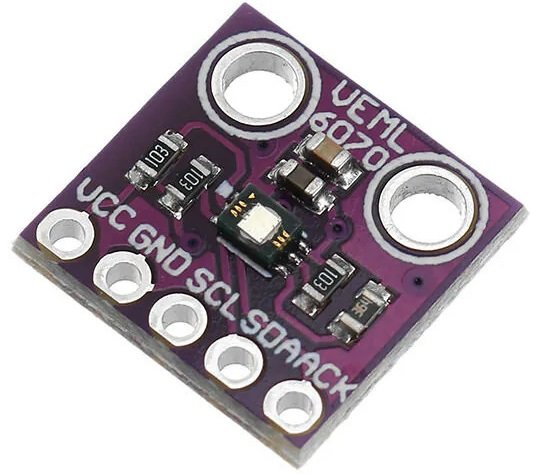
Unlike some UV sensors that estimate UV index by approximating from visible light levels, the VEML6070 contains a true UVA photodiode with spectral sensitivity specifically tuned to the UV spectrum using Vishay’s proprietary FiltronTM UV technology. The sensor has linear sensitivity to solar UV light and its refresh rate is easily adjusted via a single external resistor (RSET) connected to pin 4. A software shutdown mode is provided to reduce power consumption to below 1µA when the sensor is not actively reading.
Pinout
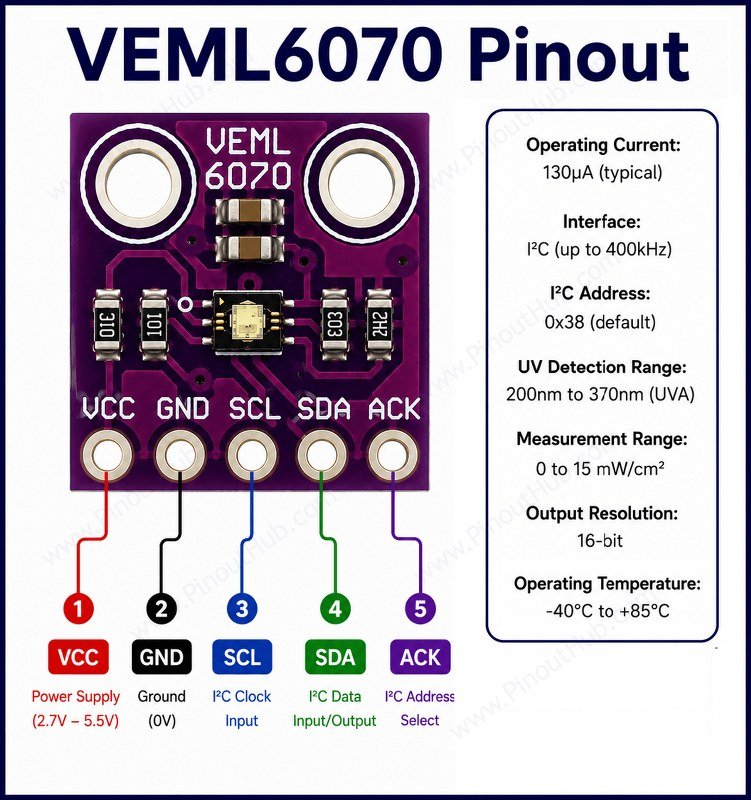
The bare VEML6070 IC is a 6-pin OPLGA package and is not breadboard-compatible. It is used on a breakout module in virtually all maker applications. Most breakout boards expose five pins through a header and include the RSET resistor (typically 270kΩ) pre-soldered onboard.
Breakout module pinout (5-pin)
| Pin | Name | Type | Description |
|---|---|---|---|
| 1 | VIN | Power | Power supply input — accepts 2.7V to 5.5V; board logic level follows this voltage |
| 2 | GND | Power | Ground |
| 3 | SCL | Input | I²C clock line — compatible with 3V and 5V logic; 10kΩ pull-up included on most breakouts |
| 4 | SDA | I/O | I²C data line — compatible with 3V and 5V logic; 10kΩ pull-up included on most breakouts |
| 5 | ACK | Output | Interrupt / alert output — goes active when UV reading crosses the programmed threshold; logic level matches VIN |
I²C addressing: The VEML6070 uses two separate I²C addresses to return a full 16-bit result. The command register is written to address 0x38. Reading UV data requires two sequential reads — the first at 0x38 returns the LSB, the second at 0x39 returns the MSB. A standard I²C scanner will detect both 0x38 and 0x39 on the bus; this is normal and expected behavior for this sensor.
RSET resistor: The refresh time and sensitivity of the VEML6070 are set by an external resistor connected between pin 4 of the IC and GND. Most breakout boards include a 270kΩ RSET resistor pre-installed, giving a default 1T refresh time of approximately 62.5ms. Changing this resistor value adjusts the timing range available through the integration time register.
VEML6070 module construction
UVA Photodiode The core sensing element — a silicon photodiode with spectral response tuned specifically to the UVA band using Vishay’s FiltronTM UV technology. Produces a photocurrent proportional to incident UVA intensity.
Amplifier and Low Pass Filter Internal amplifier stages boost the photodiode output current to a level suitable for digitisation. A low pass filter removes high-frequency noise without requiring any external RC components, simplifying PCB design around the sensor.
Oscillator and Timing Controller An internal oscillator drives the integration timing. The timing period is set by the external RSET resistor value in combination with the IT bits in the command register, giving the designer a flexible and precise way to define data collection intervals.
Temperature Sensor An onboard temperature-sensing circuit continuously monitors die temperature and applies correction to the signal path, maintaining output accuracy across the full operating temperature range.
I²C Output Buffer An open-drain I²C interface allows the sensor to communicate at both standard (100kHz) and fast (400kHz) speeds. The pull-up voltage on SDA and SCL refers to the I/O voltage of the host microcontroller; pull-up resistors of 2.2kΩ are recommended in the datasheet for reliable bus operation.
RSET Resistor (onboard on most breakouts) Connected between the IC’s RSET pin and GND, this resistor sets the base integration timing. Most breakout boards ship with a 270kΩ RSET resistor pre-soldered, giving a 1T refresh time of approximately 62.5ms. A decoupling capacitor near the VDD pin is recommended for power supply noise rejection.
Specifications
| Parameter | Value |
|---|---|
| Supply | |
| Supply Voltage (VDD) | 2.7V – 5.5V |
| Logic Voltage (SDA/SCL) | 1.7V – 5.5V |
| Operating Current | ~250µA typical |
| Shutdown Current | < 1µA |
| Sensing | |
| Detection Type | UVA (ultraviolet A) |
| Peak Sensitivity Wavelength | ~355nm |
| Spectral Technology | FiltronTM UV (Vishay) |
| Temperature Compensation | Yes (onboard) |
| Interface | |
| Communication | I²C |
| I²C Speed | 100kHz (standard) / 400kHz (fast) |
| I²C Address (command) | 0x38 |
| I²C Address (read LSB) | 0x38 |
| I²C Address (read MSB) | 0x39 |
| Command Register | 8-bit |
| Integration Time (RSET = 270kΩ) | |
| 1/2T | ~31.25ms |
| 1T (default) | ~62.5ms |
| 2T | ~125ms |
| 4T | ~250ms |
| General | |
| ACK / Interrupt | Yes, programmable threshold |
| Operating Temperature | −40°C to +85°C |
| Package | 6-pin OPLGA, 2.35 × 1.8 × 1mm |
| RoHS | Compliant |
Helpful Resources
- Download the datasheet: here
- VEML6070 with Arduino
- VEML6070 tutorial
- VEML6070 with Raspberry Pi