Orange Pi 5 is a high-performance single-board computer based on the Rockchip RK3588S SoC, featuring an octa-core CPU (Cortex-A76 + Cortex-A55) and LPDDR4/4x RAM options.
It exposes hardware interfaces through a 26-pin GPIO header and operates at 3.3V logic levels, supporting interfaces such as GPIO, I2C, SPI, UART, and PWM.
Note: Don’t confuse Orange Pi 5 with 5 Plus(40-pin). This article is about Orange Pi 5.
Official Pinout
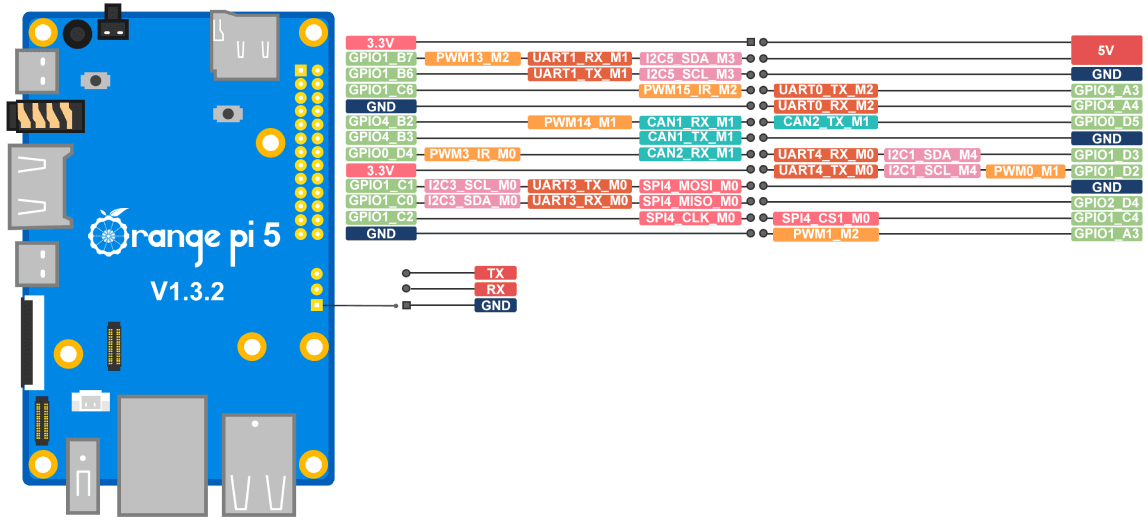
Specifications
| Feature | Details |
|---|---|
| SoC | Rockchip RK3588S (8nm) |
| CPU | 8-core (4×A76 @2.4 GHz + 4×A55 @1.8 GHz) |
| GPU | Mali-G610 MP4 |
| NPU | 6 TOPS AI accelerator |
| RAM | 4GB / 8GB / 16GB LPDDR4/4X |
| Flash | 16MB QSPI NOR |
| Storage | microSD + M.2 NVMe |
| Ethernet | Gigabit LAN |
| WiFi | No |
| Bluetooth | No |
| USB | 1× USB3.0, 2× USB2.0, 1× USB-C (3.1) |
| Video output | HDMI 2.1 (up to 8K) + DP 1.4 |
| Camera | MIPI CSI |
| Audio | ES8388 codec, 3.5mm jack |
| Expansion | GPIO/UART/SPI/I2C/PWM/CAN header |
| Power input | USB-C 5V 4A |
| Logic level | 3.3V |
Supported operating systems
- Orange Pi OS (Droid / Arch)
- Ubuntu
- Debian
- Android 12
Compatibility
- 3.3V logic level
- Supports I2C, SPI, UART, PWM & CAN
- AI-capable (6 TOPS NPU)
- USB-C powered (5V 4A)
- Not breadboard-friendly
- No built-in ADC on header
Important usage notes
- Power stability is critical. A high-quality 5V / 4A power supply is strongly recommended for AI and high-load applications.
- Many peripherals require device tree configuration to enable SPI, PWM, I2S, or additional UARTs.
- Mainline Linux support is advancing rapidly, but some hardware acceleration features (NPU, video encode/decode) may require vendor kernels or patches.
Helpful resources
- Getting started with Orange Pi 5 (video tutorial)
- Official datasheet: download pdf
- This is helpful: Orange Pi 5 benchmarks and review