The MQ3 is an analog alcohol gas sensor that detects ethanol vapour in the air by measuring changes in electrical resistance across a heated tin dioxide sensing element. It provides both an analog voltage output proportional to alcohol concentration and a digital threshold output, making it easy to interface with microcontrollers.
The sensor is commonly used in breathalyzers, alcohol detection systems, driver safety devices, and industrial alcohol monitoring applications.
What is MQ3?
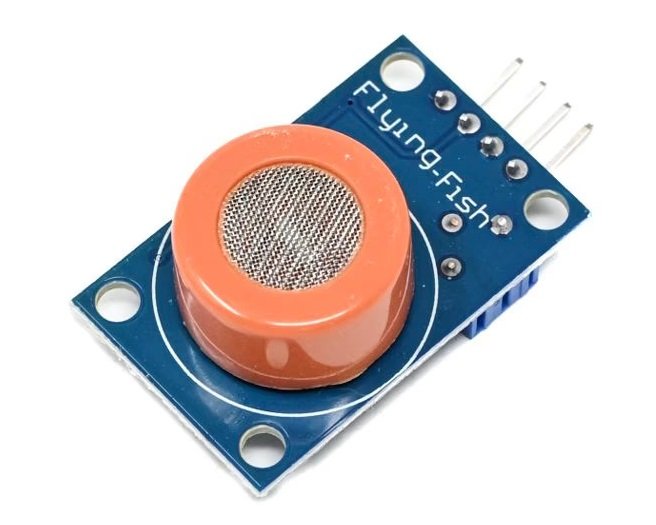
The sensitive material of the MQ3 gas sensor is SnO2, which has lower conductivity in clean air. When alcohol gas is present, the sensor’s conductivity increases along with the gas concentration. This change in conductivity is converted to a corresponding output signal through a simple circuit.
The MQ3 has high sensitivity to alcohol gas and can resist interference from gasoline, smoke, and vapour — making it reliable in real-world environments where multiple volatile compounds may be present simultaneously.
Its primary target is ethanol (C2H5OH), but like all MQ-series sensors it also responds to other gases (CO and hydrogen in particular) so it should not be used as a single-gas discriminator without additional filtering or context.
MQ3 overview
| Parameter | Value |
|---|---|
| Sensor Type | Metal Oxide Semiconductor (MOS) Gas Sensor |
| Target Gas | Alcohol (Ethanol, C2H5OH) |
| Detection Range | 25 – 500 ppm alcohol |
| Circuit Voltage (VC) | ≤24V DC (standard 5V) |
| Heater Voltage (VH) | 5.0V ±0.1V AC or DC |
| Heater Resistance | 29Ω ±3Ω (room temperature) |
| Heater Power Consumption | ≤900mW |
| Output Type | Analog (AO) + Digital TTL (DO) |
| Operating Temperature | −10°C to +50°C |
| Communication | Analog Voltage / Digital Threshold |
| Mounting Type | Through Hole (6-pin bare sensor) |
| Compatible Boards | Arduino Uno, ESP32, Raspberry Pi |
Pinout
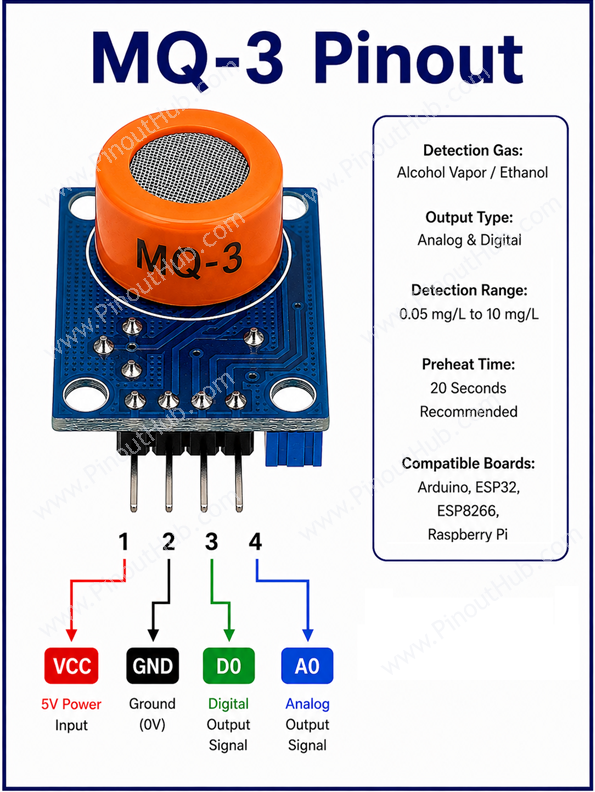
Breakout module pinout (4-pin)
| Pin | Type | Description |
|---|---|---|
| VCC | Power | Module supply — 5V |
| GND | Power | Ground |
| AO | Output | Analog output — voltage proportional to alcohol concentration (0V – 5V) |
| DO | Output | Digital TTL output — LOW when alcohol exceeds threshold, HIGH otherwise |
Working principle
The MQ3 operates on the same metal oxide semiconductor principle as the rest of the MQ series. SnO2 is a semiconductor whose resistance drops when reducing gas molecules (in this case ethanol) adsorb onto its heated surface. The higher the alcohol concentration, the lower the sensor resistance, and the higher the analog output voltage.
The sensor requires two voltage inputs: heater voltage (VH) and circuit voltage (VC). VH supplies the standard working temperature to the sensor and can use DC or AC power. VC supplies the detection voltage to the load resistance RL in series with the sensor and must be DC.
The output voltage is derived from the voltage divider formed by RS (sensor resistance) and RL (load resistance):
VOUT = VC × RL / (RS + RL)
As ethanol concentration rises, RS falls, VOUT rises, and the AO pin voltage increases toward VC. The DO pin uses an onboard LM393 comparator to convert this into a TTL HIGH/LOW threshold output.
The output voltage (Vs) in 125ppm ethanol under standard test conditions is 2.5V to 4.0V, with a recommended load resistance of 4.7kΩ.
Sensitivity to different gases (relative):
| Gas | Relative Sensitivity |
|---|---|
| Ethanol (C2H5OH) | High (primary target) |
| CO | Medium |
| H₂ | Medium |
| Gasoline / Benzene | Low (cross-sensitivity) |
Warm-up requirement: Preheat time must be over 48 hours for first use. The suggested aging times after storage are: less than one month — no less than 48 hours; 1–6 months — no less than 72 hours; more than six months — no less than 168 hours.
Inside the MQ3 Module
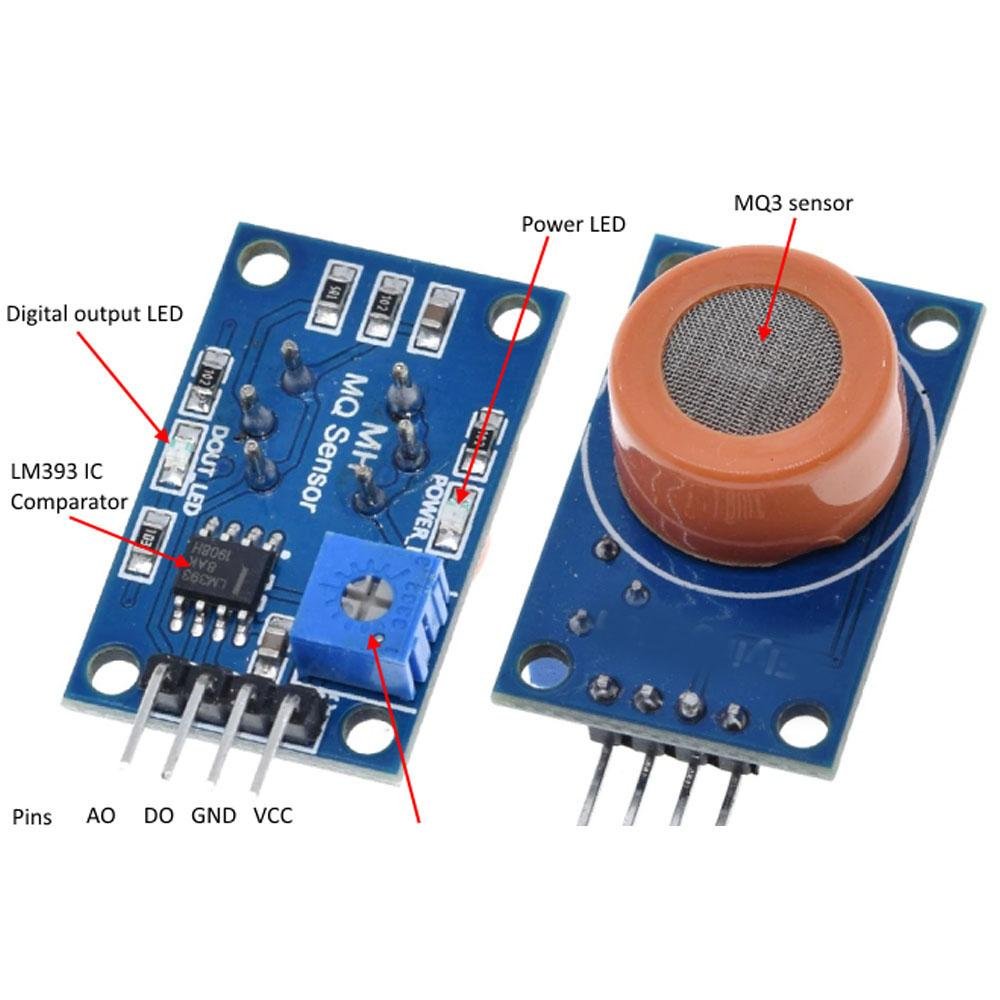
MQ3 Sensor Element The sensor is composed of a micro Al₂O₃ ceramic tube with a tin dioxide (SnO₂) sensitive layer, measuring electrodes, and a heater coil, all fixed into a crust made of plastic and stainless steel mesh. The mesh allows alcohol vapour to diffuse in while acting as a flame arrestor, preventing any ignition inside the heated sensing chamber from propagating outward.
LM393 Voltage Comparator Converts the analog signal from the sensor into a digital TTL output. It compares the sensor voltage against the reference set by the potentiometer and switches the DO pin LOW when the threshold is exceeded.
Sensitivity Adjustment Potentiometer Sets the reference voltage for the LM393 comparator. Turning it clockwise raises the threshold concentration at which DO triggers; counter-clockwise lowers it. Calibrating against a known alcohol concentration gives the most reliable results.
Power LED Illuminates when 5V is applied to VCC, confirming the module is powered and the heater coil is active.
Threshold LED Turns on when the DO pin triggers, providing a quick visual indication that alcohol concentration has crossed the set threshold without needing a microcontroller or serial monitor.
Decoupling Capacitors Filter noise on the 5V supply rail. The heater draws up to 180mA continuously, which can introduce supply ripple that affects analog output accuracy if not properly filtered.
Specifications
| Parameter | Value |
|---|---|
| Target Gas | Alcohol (Ethanol, C2H5OH) |
| Detection Range | 25 – 500 ppm alcohol |
| Circuit Voltage (VC) | ≤24V DC (standard 5V ±0.1V) |
| Heater Voltage (VH) | 5.0V ±0.1V (AC or DC) |
| Heater Resistance | 29Ω ±3Ω (room temperature) |
| Heater Power Consumption | ≤900mW |
| Heater Current | ~180mA (typical at 5V) |
| Sensitivity (S) | Rs(air) / Rs(125ppm C2H5OH) ≥ 5 |
| Output Voltage (Vs) | 2.5V – 4.0V (in 125ppm C2H5OH) |
| Concentration Slope (α) | ≤0.6 (R300ppm / R50ppm C2H5OH) |
| Recommended Load Resistance | 4.7kΩ (RL adjustable) |
| Analog Output (AO) | 0V – 5V |
| Digital Output (DO) | TTL — LOW when gas exceeds threshold |
| Comparator IC | LM393 |
| DO Threshold | Adjustable via onboard potentiometer |
| Preheat Time (first use) | ≥48 hours |
| Preheat Time (after 1–6 months storage) | ≥72 hours |
| Preheat Time (after 6+ months storage) | ≥168 hours |
| Standard Test Temperature | 20°C ±2°C |
| Standard Test Humidity | 55% ±5% RH |
| Operating Temperature | −10°C to +50°C |
| Operating Humidity | <95% RH (non-condensing) |
| Module Supply | 5V DC |
| Sensor Package | 6-pin through hole (TO-5 metal can) |
Helpful resources
- Download the datasheet: PDF here
- MQ3 with Arduino
- MQ3 with ESP32