The HC-SR501 is a low-cost passive infrared (PIR) motion sensor module that detects movement by sensing changes in infrared radiation emitted by warm bodies, such as humans and animals, passing within its field of view. By comparing infrared levels over time, it can provide a simple digital HIGH/LOW output whenever motion is detected.
This makes the HC-SR501 ideal for applications such as automated lighting, home security systems, motion-activated alarms, occupancy sensing, and energy-saving automation. Its low cost, standalone operation, and simple digital interface have made it one of the most popular motion sensors in the maker community.
What is HC-SR501?
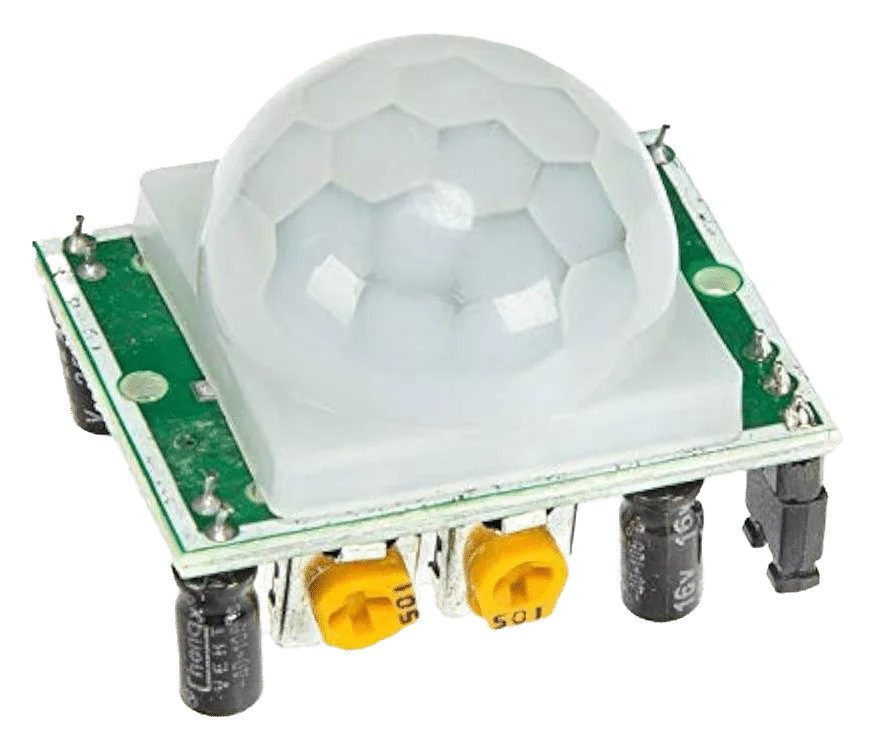
The HC-SR501 PIR motion sensor module is built around the BISS0001 Micro Power PIR Motion Detector IC, which processes signals from the PIR sensing element. Removing the Fresnel lens reveals the RE200B pyroelectric sensing element underneath — the component that actually detects infrared radiation. There are two important materials present in the sensor: the pyroelectric crystal, which detects heat signatures from a living organism, and the Fresnel lens, which widens the effective range of the sensor.
The BISS0001 IC handles all the signal conditioning and timing internally. When the pyroelectric sensor detects a change in infrared radiation, it sends a signal that is processed by the BISS0001 chip. If the signal is determined to be valid, the chip’s output goes high for a duration that can be adjusted using the onboard variable resistor. This means the module requires no external microcontroller logic to function — it can be used standalone or to enhance a larger project connected to a platform like Arduino or Raspberry Pi.
Note on output current: The HC-SR501 module does not require any extra components or platforms to work as a ready-to-use unit — power and ground plus the output pin are all that’s needed. However, because it is a low-current device, it cannot directly drive high-current loads; a transistor or relay must be used at the output to switch larger loads.
HC-SR501 overview
| Parameter | Value |
|---|---|
| Sensor Type | Passive Infrared (PIR) Motion Sensor |
| Sensing Element | RE200B pyroelectric sensor |
| Control IC | BISS0001 |
| Supply Voltage | 4.5V – 20V (5V recommended) |
| Output Type | Digital (TTL, 3.3V) |
| Detection Range | Up to 7 meters (adjustable) |
| Detection Angle | ~120° |
| Idle Current | ~50µA |
| Active Current | ~65mA |
| Warm-up Time | 30–60 seconds |
| Trigger Modes | Repeatable (H) / Non-repeatable (L) |
| Compatible Boards | Arduino, ESP32, Raspberry Pi |
| Dimensions | ~32 × 24mm (PCB), with Fresnel lens dome |
Pinout
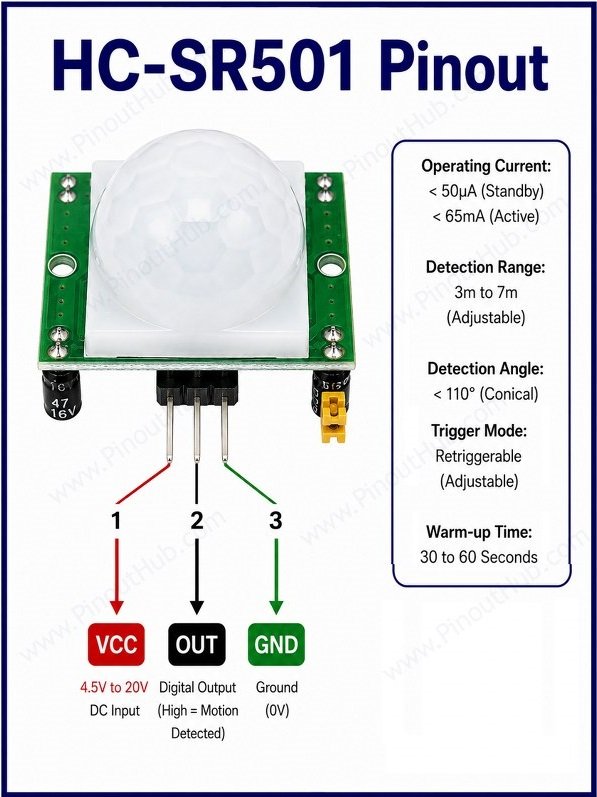
The HC-SR501 module ships fully assembled on a small PCB with a white Fresnel lens dome on the front and two adjustable potentiometers plus a jumper on the back. It has a simple 3-pin header for connection.
3-pin header pinout
| Pin | Name | Type | Description |
|---|---|---|---|
| 1 | VCC | Power | Power supply input — accepts 4.5V to 20V DC; connect to 5V for typical use |
| 2 | OUT | Output | Digital output — goes HIGH (3.3V) when motion is detected, LOW (0V) when no motion is present |
| 3 | GND | Power | Ground connection |
Onboard adjustments: The sensitivity potentiometer controls detection distance rotating it clockwise increases the sensing range, up to a maximum of approximately 7 meters. A second potentiometer adjusts the output HIGH time delay (how long OUT stays high after a trigger). A 3-pin jumper selects the trigger mode: L (Non-repeatable) resets the timer on each new trigger only after the previous delay expires, while H (Repeatable) restarts the output delay every time new motion is detected within the active window.
Working principle
PIR stands for Passive Infrared sensor. It is an electronic sensor that detects changes in infrared light across a certain distance and produces an electrical signal at its output in response. It can detect any infrared-emitting object, such as a human or animal, as it enters, exits, or moves within the sensor’s range.
The Fresnel lens dome on the front of the module splits the sensor’s field of view into multiple detection zones. As a warm body moves across these zones, the infrared radiation falling on the RE200B pyroelectric element fluctuates. This raw fluctuating signal is fed into the BISS0001 IC, which filters and amplifies it, compares it against a threshold, if the signal qualifies as genuine motion drives the OUT pin HIGH for a duration set by the delay potentiometer.
Trigger modes: In repeatable (H) mode, the output pin goes high when a person is detected within range and stays high as long as they remain within the sensor’s field of view; once the person leaves the area, the pin goes low after the time set by the delay potentiometer. In non-repeatable (L) mode, the output goes high for a fixed period regardless of continued motion, then goes low and re-arms only afterward.
Warm-up behavior: After power-up, the HC-SR501 requires a 30–60 second initialization period, during which it may trigger falsely multiple times. This is normal behavior as the sensor calibrates and stabilizes to its surrounding infrared environment.
HC-SR501 module construction
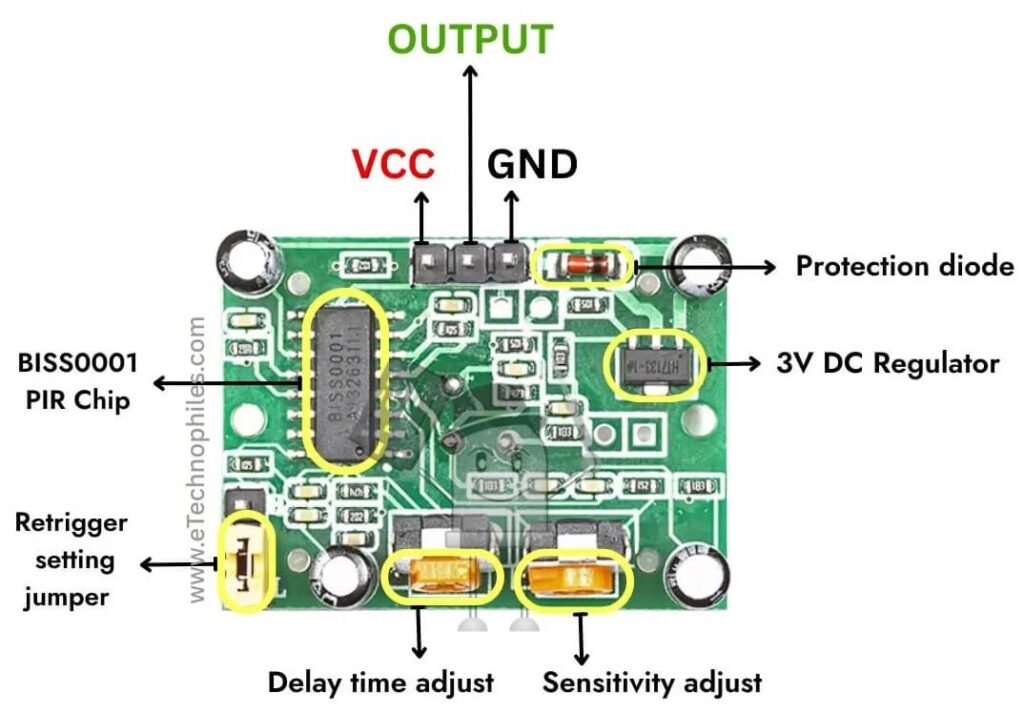
RE200B Pyroelectric Sensor The actual sensing element, hidden beneath the white Fresnel lens dome. Contains two internal sensing slots wired in a differential configuration so the output responds to changes in infrared radiation across the field of view, rather than absolute IR levels — this is what makes it respond to movement rather than static heat sources.
Fresnel Lens The domed white plastic cover over the sensor. It splits the field of view into multiple separate detection zones and focuses infrared light from a wide area onto the small RE200B element, extending the effective range and angle of detection well beyond what the bare sensor could achieve alone.
BISS0001 IC A low-power, high-quality, and reliable PIR signal processing chip built with CMOS technology, responsible for amplifying, filtering, and qualifying the raw pyroelectric signal before driving the digital output pin.
Sensitivity Potentiometer Adjusts the detection threshold and effective range, typically up to 7 meters at maximum sensitivity.
Delay Potentiometer Sets how long the OUT pin remains HIGH after a valid motion trigger.
Trigger Mode Jumper A 3-pin jumper block selecting between Repeatable (H) and Non-repeatable (L) output behavior.
Specifications
| Parameter | Value |
|---|---|
| Supply Voltage | 4.5V – 12V (5V recommended) |
| Idle Current | ~50µA |
| Active Current | ~65mA |
| Output Voltage (HIGH) | 3.3V TTL |
| Output Voltage (LOW) | 0V |
| Detection Range | Up to 7m, adjustable |
| Detection Angle | ~120° cone |
| Delay Time | Adjustable, ~3s – 300s (potentiometer dependent) |
| Trigger Modes | Repeatable (H) / Non-repeatable (L) |
| Warm-up Time | 30–60 seconds |
| Sensing Element | RE200B pyroelectric sensor |
| Control IC | BISS0001 |
| Operating Temperature | −20°C to +80°C (typical) |
| Package | PCB module with Fresnel lens dome |
Helpful resources
- Download the datasheet: here
- HC-SR501 with Arduino
- HC-SR501 with ESP32
- HC-SR501 PIR Sensor with Raspberry Pi: Tutorial