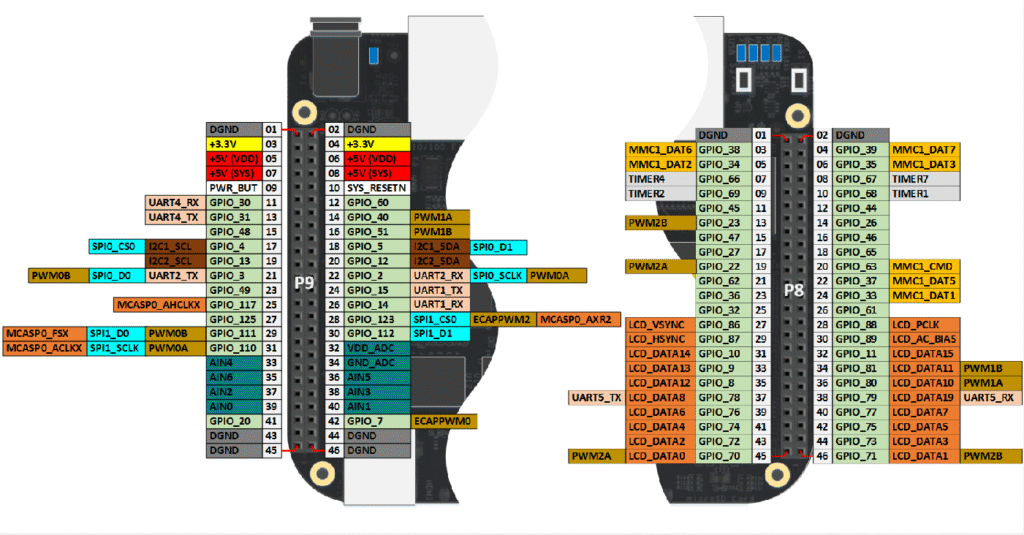
The BeagleBone Black Rev C is a powerful open-source single-board computer built around the Texas Instruments AM335x ARM Cortex-A8 processor. It includes 512 MB DDR3 RAM, onboard 4 GB eMMC flash, and exposes extensive I/O through two 46-pin headers. Given below is the pin mapping of the board.
Pinout diagram
P9 Header (Power, Analog, I2C, UART, SPI)
Pin
Signal
Function
P9_1
GND
Ground
P9_2
GND
Ground
P9_3
3.3V
3.3V output
P9_4
3.3V
3.3V output
P9_5
VDD_5V
5V output
P9_6
VDD_5V
5V output
P9_7
SYS_5V
5V input
P9_8
SYS_5V
5V input
P9_9
PWR_BTN
Power button
P9_10
SYS_RESETn
System reset
P9_11
UART4_RXD
UART4 receive
P9_12
GPIO1_28
GPIO
P9_13
UART4_TXD
UART4 transmit
P9_14
EHRPWM1A
PWM
P9_15
GPIO1_16
GPIO
P9_16
EHRPWM1B
PWM
P9_17
I2C1_SCL
I2C clock
P9_18
I2C1_SDA
I2C data
P9_19
I2C2_SCL
I2C clock
P9_20
I2C2_SDA
I2C data
P9_21
UART2_TXD
UART2 transmit
P9_22
UART2_RXD
UART2 receive
P9_23
GPIO1_17
GPIO
P9_24
UART1_TXD
UART1 transmit
P9_25
GPIO3_21
GPIO
P9_26
UART1_RXD
UART1 receive
P9_27
GPIO3_19
GPIO
P9_28
SPI1_CS0
SPI chip select
P9_29
SPI1_MISO
SPI MISO
P9_30
SPI1_MOSI
SPI MOSI
P9_31
SPI1_SCLK
SPI clock
P9_32
VDD_ADC
ADC reference
P9_33
AIN4
Analog input
P9_34
GND
Ground
P9_35
AIN6
Analog input
P9_36
AIN5
Analog input
P9_37
AIN2
Analog input
P9_38
AIN3
Analog input
P9_39
AIN0
Analog input
P9_40
AIN1
Analog input
P9_41
CLKOUT2
Clock output
P9_42
GPIO0_7
GPIO
P9_43
GND
Ground
P9_44
GND
Ground
P9_45
GND
Ground
P9_46
GND
Ground
P9 header pin mapping
P8 Header (GPIO, PWM, PRU)
Pin
Signal
Function
P8_1
GND
Ground
P8_2
GND
Ground
P8_3
GPIO1_6
GPIO
P8_4
GPIO1_7
GPIO
P8_5
GPIO1_2
GPIO
P8_6
GPIO1_3
GPIO
P8_7
TIMER4
Timer
P8_8
TIMER7
Timer
P8_9
TIMER5
Timer
P8_10
TIMER6
Timer
P8_11
GPIO1_13
GPIO
P8_12
GPIO1_12
GPIO
P8_13
EHRPWM2B
PWM
P8_14
GPIO0_26
GPIO
P8_15
GPIO1_15
GPIO
P8_16
GPIO1_14
GPIO
P8_17
GPIO0_27
GPIO
P8_18
GPIO2_1
GPIO
P8_19
EHRPWM2A
PWM
P8_20
GPIO1_31
GPIO
P8_21
GPIO1_30
GPIO
P8_22
GPIO1_5
GPIO
P8_23
GPIO1_4
GPIO
P8_24
GPIO1_1
GPIO
P8_25
GPIO1_0
GPIO
P8_26
GPIO1_29
GPIO
P8_27
GPIO2_22
GPIO
P8_28
GPIO2_24
GPIO
P8_29
GPIO2_23
GPIO
P8_30
GPIO2_25
GPIO
P8_31
UART5_TXD
UART5 transmit
P8_32
UART5_RXD
UART5 receive
P8_33
GPIO0_9
GPIO
P8_34
GPIO2_17
GPIO
P8_35
GPIO0_8
GPIO
P8_36
GPIO2_16
GPIO
P8_37
UART5_CTS
UART
P8_38
UART5_RTS
UART
P8_39
GPIO2_12
GPIO
P8_40
GPIO2_13
GPIO
P8_41
GPIO2_10
GPIO
P8_42
GPIO2_11
GPIO
P8_43
GPIO2_8
GPIO
P8_44
GPIO2_9
GPIO
P8_45
GPIO2_6
GPIO
P8_46
GPIO2_7
GPIO
P8 header pin mapping
Pinout at a glance
Feature
Count
Expansion headers
92 pins total
GPIO pins
~65 usable
ADC channels
7 (12-bit)
PWM outputs
Multiple (up to 8+)
UART ports
5–6
I2C buses
2
SPI buses
2
CAN
2
5V pins
Multiple
3.3V pins
Multiple
Ground pins
Multiple
Specifications
Feature
Details
Processor
TI Sitara AM3358 (1 GHz Cortex-A8)
RAM
512 MB DDR3
Onboard storage
4 GB eMMC
GPIO headers
2 × 46-pin (P8 & P9)
Logic level
3.3V
ADC
7 channels (12-bit)
USB
1 × USB host, 1 × USB client
HDMI
Micro-HDMI
Networking
10/100 Ethernet
Storage expansion
microSD
Power input
5V barrel jack or Mini-USB
Compatibility
3.3V logic level
Not breadboard-friendly
Runs Linux (Debian, Ubuntu, custom images)
Supports Python, C/C++, Node.js
Built-in ADC available
Compatible with PRU-based real-time applications
Important Usage Notes
All I/O pins are 3.3V only and not 5V tolerant
The ADC inputs accept 0–1.8V max, not 3.3V (important!)
Some pins are reserved for HDMI and eMMC unless disabled in software
Pin configuration is controlled through device tree overlays in Linux
Helpful resources
Get started with BeagleBone Black Rev C(video tutorial):