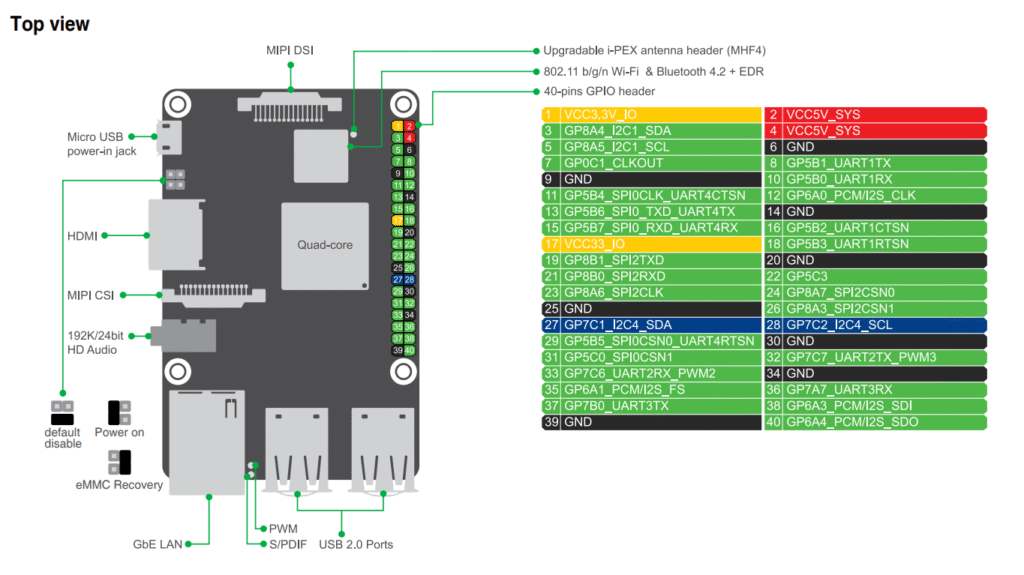
ASUS Tinker Board R2.0 is a single-board computer based on the Rockchip RK3288 SoC, featuring a quad-core ARM Cortex-A17 CPU, 2 GB LPDDR3 RAM, and a 40-pin GPIO header compatible with many Raspberry Pi HAT form factors. It operates at 3.3V logic levels and supports common interfaces such as I2C, SPI, UART, PWM, and I2S through its header pins.
Pinout
Feature
Count
Header pins
40
Usable GPIO pins
Up to 28 (multiplexed)
PWM channels
2
I2C buses
1
SPI buses
1
UART ports
2
5V power pins
2
3.3V power pins
2
Ground pins
8
ADC
Not available
Pin functions
GPIO2 (SDA) → I2C data
GPIO3 (SCL) → I2C clock
GPIO14 (TXD) → UART transmit
GPIO15 (RXD) → UART receive
GPIO10 (MOSI) → SPI MOSI
GPIO9 (MISO) → SPI MISO
GPIO11 (SCLK) → SPI clock
GPIO8 (CE0) → SPI chip select
GPIO18 → PWM capable
GPIO19 → PWM / I2S capable
5V pins (2, 4) → Direct 5V supply from power input
3.3V pins (1, 17) → Regulated 3.3V output
GND pins → Common ground reference
Specifications
Feature
Details
SoC
Rockchip RK3288
CPU
Quad-core ARM Cortex-A17
RAM
2 GB LPDDR3
GPU
Mali-T764
GPIO header
40-pin
Logic level
3.3V
USB
4 × USB 2.0
HDMI
Full-size HDMI
Networking
Gigabit Ethernet
Storage
microSD card
Power input
5V via Micro-USB
Asus Tinkerboard R2.0 specs table
Compatibility
3.3V logic level
Supports I2C, SPI & UART
Raspberry Pi HAT-compatible header
Micro-USB powered (5V)
Not breadboard-friendly
No built-in ADC
Supports TinkerOS (Debian-based), Android, Armbian (community-supported), and other Linux distributions (community builds)
Important usage notes
GPIO operates at 3.3V logic and is not 5V tolerant — level shifting is required for 5V modules
Many header pins are multiplexed (shared between GPIO, I2C, SPI, I2S, etc.), so enabling one function may disable another in software
Some interfaces (SPI, I2S, additional UARTs) may need to be enabled in the OS before use
The 40-pin header is layout-compatible with Raspberry Pi, but not all pins have identical functions