The Banana Pi M5 is a compact single-board computer based on the Amlogic S905X3 SoC, featuring a quad-core ARM Cortex-A55 CPU, 4 GB LPDDR4 RAM, and a 40-pin GPIO header that follows the Raspberry Pi–style layout. The board operates at 3.3V logic levels and exposes commonly used interfaces such as I2C, SPI, UART, PWM, and I2S through its GPIO header.
Designed for embedded Linux applications, media playback, and lightweight server tasks, the Banana Pi M5 offers improved efficiency and performance over earlier Cortex-A53–based boards.
Pinout
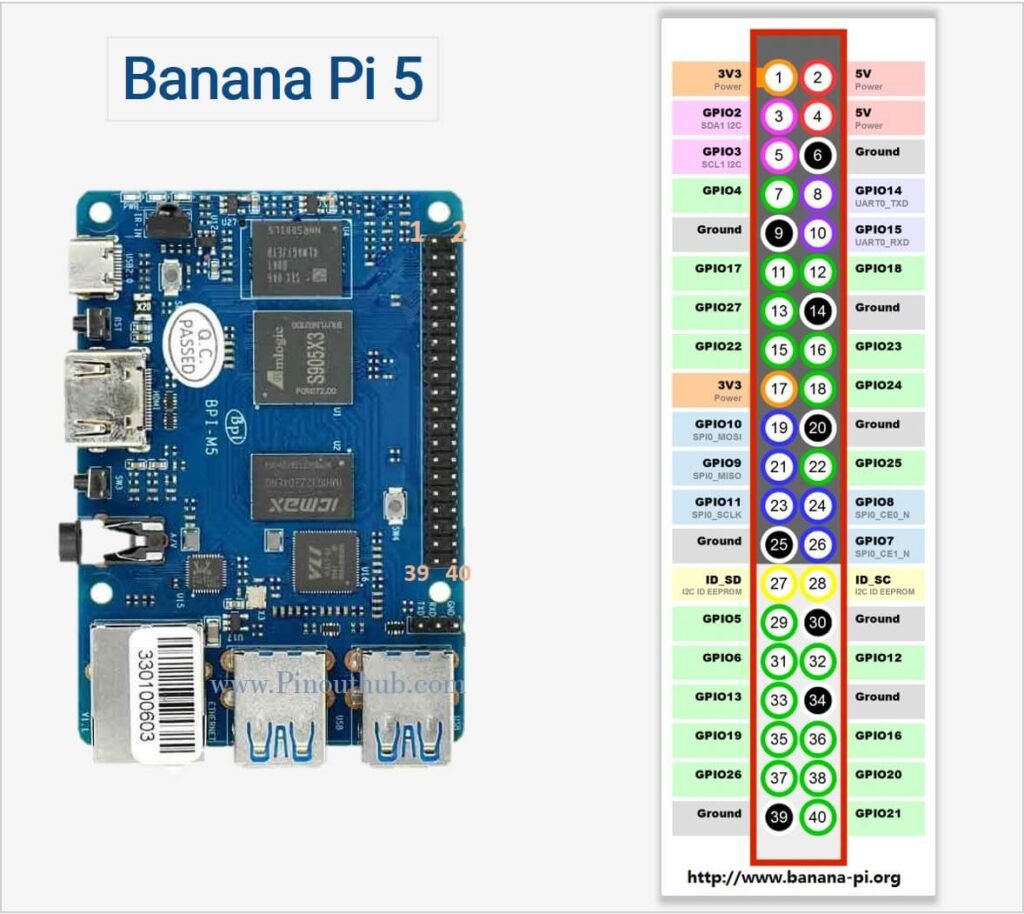
| Feature | Count |
|---|---|
| Header pins | 40 |
| Usable GPIO pins | Up to 28 (multiplexed) |
| PWM channels | 2 |
| I2C buses | 2 |
| SPI buses | 1 |
| UART ports | 2 (header) |
| 5V power pins | 2 |
| 3.3V power pins | 2 |
| Ground pins | 8 |
| ADC | Not available |
Pin Functions
- GPIO2 (SDA) → I2C data (I2C-M3 in DTB)
- GPIO3 (SCL) → I2C clock (I2C-M3)
- GPIO14 (TXD) → UART transmit (header UART)
- GPIO15 (RXD) → UART receive (header UART)
- GPIO10 (MOSI) → SPI MOSI (SPI-A)
- GPIO9 (MISO) → SPI MISO (SPI-A)
- GPIO11 (SCLK) → SPI clock
- GPIO8 (CE0) → SPI chip select
- GPIO18 → PWM capable (shared with I2S)
- GPIO19 → PWM / I2S capable
- 5V pins (2, 4) → Direct 5V input
- 3.3V pins (1, 17) → Regulated 3.3V output
- GND pins → Common ground reference
Specifications
| Feature | Details |
|---|---|
| SoC | Amlogic S905X3 |
| CPU | Quad-core ARM Cortex-A55 (up to 2.0 GHz) |
| RAM | 4 GB LPDDR4 |
| Storage | 16 GB / 32 GB / 64 GB onboard eMMC + microSD slot |
| GPU | Mali-G31 MP2 |
| GPIO header | 40-pin |
| Logic level | 3.3V (strict) |
| USB | 4 × USB 3.0 |
| HDMI | HDMI 2.1 |
| Networking | Gigabit Ethernet (Realtek RTL8211F) |
| Power input | 5V via USB Type-C |
Supported OS
- Android
- Ubuntu
- Debian
- Armbian
- Banana Pi Linux builds
Compatibility
- 3.3V GPIO logic (not 5V tolerant)
- Raspberry Pi–style 40-pin header layout
- USB Type-C powered (recommended 5V / 3A supply)
- Requires jumper wires or a GPIO breakout board for breadboard prototyping
- No onboard ADC
Important Usage Notes
- 5V Warning: GPIO pins are not 5V tolerant.
- Power delivery is critical. Low-quality phone chargers can cause under-voltage throttling during CPU load spikes.
- Some peripherals require manual enabling via device tree overlays.
- Mainline Linux support is improving, but full GPIO control, multimedia acceleration, and I/O features are currently best supported under the 4.9.x vendor kernel.
Helpful Resources
- Introduction to Banana Pi M5 (video tutorial)
- Download datasheet official pdf
- Benchmarks: product page