The Raspberry Pi 3 Model B is a versatile single-board computer powered by a 1.2 GHz 64-bit quad-core processor, featuring built-in Wi-Fi, Bluetooth 4.1, Ethernet, and a full 40-pin GPIO header—making it ideal for learning, prototyping, retro gaming, and a wide range of embedded and IoT projects. Here’s the full pinout to help you get started with the Raspberry Pi 3B GPIO.
RPi 3B GPIO Pinout
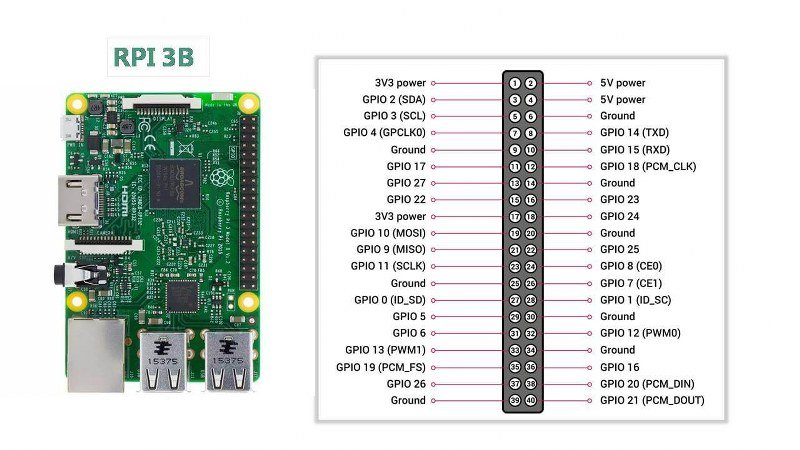
| Pin | Name / Function | Pin | Name / Function |
|---|---|---|---|
| 1 | 3.3V Power | 2 | 5V Power |
| 3 | GPIO2 (SDA1) | 4 | 5V Power |
| 5 | GPIO3 (SCL1) | 6 | Ground |
| 7 | GPIO4 | 8 | GPIO14 (TXD0) |
| 9 | Ground | 10 | GPIO15 (RXD0) |
| 11 | GPIO17 | 12 | GPIO18 (PCM_CLK / PWM0) |
| 13 | GPIO27 | 14 | Ground |
| 15 | GPIO22 | 16 | GPIO23 |
| 17 | 3.3V Power | 18 | GPIO24 |
| 19 | GPIO10 (MOSI) | 20 | Ground |
| 21 | GPIO9 (MISO) | 22 | GPIO25 |
| 23 | GPIO11 (SCLK) | 24 | GPIO8 (CE0) |
| 25 | Ground | 26 | GPIO7 (CE1) |
| 27 | ID_SD (I²C EEPROM) | 28 | ID_SC (I²C EEPROM) |
| 29 | GPIO5 | 30 | Ground |
| 31 | GPIO6 | 32 | GPIO12 (PWM0) |
| 33 | GPIO13 (PWM1) | 34 | Ground |
| 35 | GPIO19 (PCM_FS / SPI1 MISO) | 36 | GPIO16 |
| 37 | GPIO26 | 38 | GPIO20 (PCM_DIN / SPI1 MOSI) |
| 39 | Ground | 40 | GPIO21 (PCM_DOUT / SPI1 SCLK) |
Raspberry Pi 3 Model B Specifications
The 3B was the first “modern” Pi, moving to a 64-bit architecture while maintaining the classic form factor.
| Feature | Specification | Key Detail |
|---|---|---|
| Processor | Quad-core ARM Cortex-A53 @ 1.2 GHz | 64-bit capable, efficient for multitasking |
| GPU | Broadcom VideoCore IV | Supports OpenGL ES 2.0, 1080p video |
| RAM | 1GB LPDDR2 | Shared with GPU |
| USB Ports | 4× USB 2.0 | Shared bandwidth |
| Networking | 10/100 Ethernet | Via USB 2.0 controller |
| Wireless | 2.4 GHz 802.11n Wi-Fi | First Pi with built-in Wi-Fi |
| Bluetooth | Bluetooth 4.1 | Classic + BLE support |
| Storage | microSD slot | Boot and OS storage |
| Power Input | 5V / 2.5A micro-USB | Standard Pi power requirement |
| GPIO Header | 40-pin standard layout | HAT compatible |
| Video Output | HDMI (Full-size) | Up to 1080p |
| Dimensions | 85 × 56 mm | Standard Raspberry Pi form factor |
Compatibility
- 3.3V Logic Level
- Powered via Micro-USB (5V / 2.5A recommended)
- Single 1080p Display Support
- No Built-In ADC
Helpful Resources
1. GPIO Guide: video tutorial
2. Benchmark and review: article